
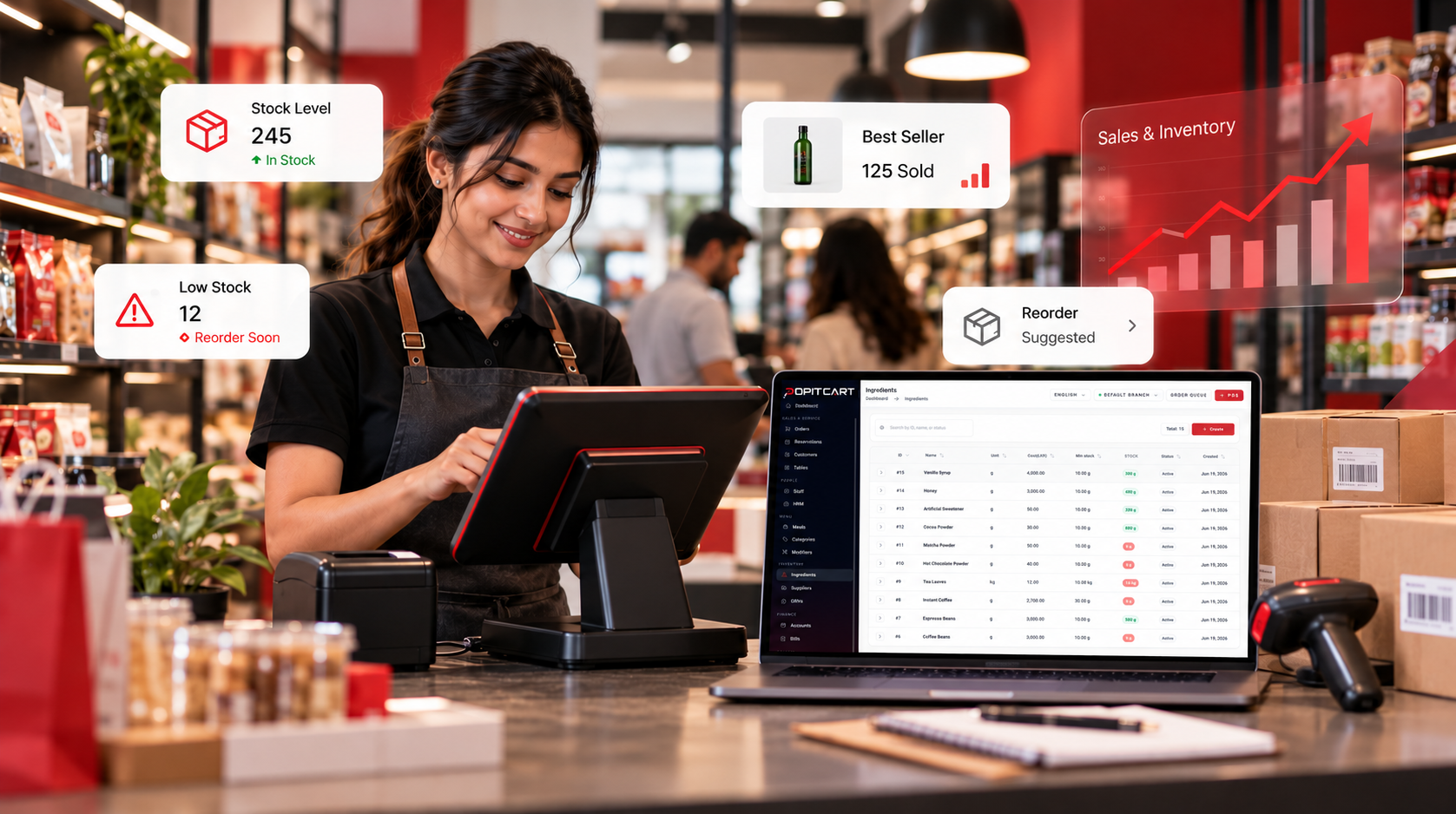
Running a successful retail business is not only about making sales. Behind every successful sale is an important question:
Do you have the right product, in the right quantity, at the right time?
This is where Inventory Management becomes essential.
For retail businesses, inventory represents a significant investment. Poor stock management can lead to overstocking, stock shortages, expired or damaged products, inaccurate reports, and missed sales opportunities.
A modern POS and Inventory Management System can help businesses keep better control of their stock while connecting inventory activity directly with sales and purchasing.
PopitCart — The Hybrid AI Commerce System helps businesses bring these processes together so they can manage products, sales, purchases, units, and stock more efficiently.
What Is Inventory Management?
Inventory Management is the process of tracking and controlling the products a business purchases, stores, sells, and replenishes.
It helps a business answer important questions such as:
- How much stock do we currently have?
- Which products are selling quickly?
- Which products are moving slowly?
- Which products need to be reordered?
- How much stock was purchased?
- How much stock has been sold?
- Are there differences between actual and recorded stock?
- Which products or variations are performing well?
Without proper inventory management, answering these questions can become difficult, especially as a business grows.
1. Prevent Stock Shortages
One of the biggest problems in retail is running out of products that customers want to buy.
Imagine a customer visits your store looking for a popular product, but your system does not accurately show the available stock. If the product is unavailable, you may lose that sale—and potentially that customer.
A proper inventory management system helps businesses monitor stock levels and identify products that may need replenishment.
By keeping track of stock movement, businesses can plan purchases before essential products run out.
2. Avoid Overstocking
Having too little stock can cause problems, but having too much stock can also be expensive.
Excess inventory can:
- Tie up business capital
- Require additional storage space
- Increase the risk of damage
- Increase the risk of expired products
- Make slow-moving products harder to identify
Effective inventory management helps businesses understand which products are moving quickly and which products may require closer attention.
This allows purchasing decisions to be based more closely on actual business activity.
3. Know Exactly What You Have in Stock
Manual stock tracking can become increasingly difficult as a business grows.
A small shop may start with a simple notebook or spreadsheet. But as the number of products, variations, suppliers, and transactions increases, manually updating everything becomes time-consuming.
A connected POS and inventory system can automatically use sales and purchasing information to maintain a more up-to-date view of stock.
This means business owners and managers can spend less time manually calculating stock and more time managing the business.
4. Connect Sales With Inventory
One of the biggest advantages of using a POS system with inventory management is the connection between sales and stock.
When a product is sold, the corresponding inventory information can be updated as part of the sales process.
This creates a connected flow:
Purchase → Stock → Sale → Inventory Update → Business Report
Instead of maintaining separate records for each process, businesses can manage these activities through a connected system.
PopitCart is designed to connect POS operations with inventory-related processes, helping businesses maintain better visibility across their daily operations.
5. Manage Different Units Easily
Retail and other businesses often sell products using different measurement units.
For example:
- PCS
- KG
- g
- L
- ML
A business may also need to manage products using different quantities and measurements depending on how they are purchased or sold.
Proper Unit Management helps businesses maintain more accurate inventory records.
For example, if a product is purchased in kilograms but managed or sold using smaller quantities, the system should be able to support the relevant unit structure.
This becomes especially important for businesses dealing with food, beverages, groceries, wholesale products, and other unit-based inventory.
6. Manage Product Variations
Many retail businesses sell products that have different variations.
For example:
- Different sizes
- Different colors
- Different weights
- Different packaging
- Different models
Each variation may have its own barcode, price, and stock quantity.
A good inventory system should allow businesses to manage these variations separately while still keeping them connected to the main product.
This makes stock tracking more accurate and makes it easier for employees to identify the correct product during sales.
7. Improve Purchasing Decisions
Purchasing too much or too little can both affect profitability.
Inventory information can help business owners understand purchasing requirements before placing new orders.
For example, businesses can review:
- Current stock
- Previous purchases
- Sales activity
- Fast-moving products
- Slow-moving products
- Product demand patterns
With this information available, purchasing can become more structured and data-driven.
Instead of asking, "How much should we buy?", business owners can first look at the actual information available from their business operations.
8. Reduce Inventory Errors
Inventory differences can happen for many reasons.
Common causes include:
- Incorrect product entries
- Manual calculation errors
- Unrecorded sales
- Incorrect quantities
- Damaged products
- Incorrect unit assignments
- Stock transfers
- Returns
When inventory is managed manually, identifying the source of a difference can take considerable time.
A connected inventory system provides a clearer record of stock movement, making it easier to review where changes occurred.
9. Make Barcode Scanning Faster
Barcode technology can significantly improve retail inventory and checkout operations.
Instead of manually searching for a product every time, employees can scan the barcode and quickly identify the relevant product.
For compatible PCS products, PopitCart can also support direct addition to the current order after scanning, without opening the product modal.
This can reduce unnecessary steps and make the checkout process faster.
10. Manage Purchases and Goods Received
Inventory management does not begin when a product is sold.
It begins when stock enters the business.
Businesses need to record:
Supplier → Purchase → Goods Received → Stock → Sale
A Goods Received Note (GRN) process can help businesses record incoming inventory and maintain a clearer history of received products.
This can be particularly useful for businesses that regularly receive stock from multiple suppliers.
With a structured GRN and inventory process, businesses can improve visibility into:
- Supplier information
- Received quantities
- Purchase references
- Product costs
- Dates
- Stock status
11. Reduce Product Waste and Losses
Some products have limited shelf lives.
This is particularly important for:
- Restaurants
- Grocery stores
- Supermarkets
- Bakeries
- Cafés
- Food retailers
Poor inventory management can result in products remaining unnoticed until they expire or become unusable.
By monitoring stock movement and identifying slow-moving products, businesses can take appropriate action earlier.
Better inventory visibility can therefore help reduce unnecessary waste.
12. Improve Customer Satisfaction
Inventory management may seem like an internal business process, but it directly affects customers.
When products are available when customers need them, the overall shopping experience improves.
Customers do not want to repeatedly hear:
"Sorry, we're out of stock."
Accurate inventory information can help businesses maintain better product availability and provide customers with more reliable service.
13. Make Business Reports More Useful
Inventory data becomes even more valuable when it is connected with sales and business reports.
Business owners can gain better visibility into:
- Product sales
- Stock movement
- Purchasing
- Inventory levels
- Product performance
- Supplier activity
Instead of viewing sales and inventory as separate areas, businesses can understand how they affect each other.
This creates a more complete picture of business performance.
14. Support Business Growth
Inventory management becomes increasingly important as a business grows.
A small business may have a limited number of products and suppliers.
But as the business expands, it may have:
- Hundreds or thousands of products
- Multiple product variations
- Multiple suppliers
- Multiple employees
- Multiple branches
- Larger transaction volumes
At this stage, manual inventory management can become difficult to maintain.
A scalable inventory system gives businesses a stronger foundation for managing increasing operational complexity.
How PopitCart Helps With Inventory Management
PopitCart — The Hybrid AI Commerce System connects POS and business management capabilities to help businesses maintain better control over their inventory.
With PopitCart, businesses can manage areas such as:
✓ Product Management
Organize products, categories, variations, and units.
✓ Stock Management
Monitor stock quantities and movement.
✓ Unit Management
Work with units such as PCS, KG, g, L, and ML.
✓ Barcode Management
Use barcode scanning to identify products quickly.
✓ Purchase Management
Record purchases and incoming stock.
✓ GRN Management
Maintain structured records of goods received from suppliers.
✓ POS Integration
Connect sales activity with inventory operations.
✓ Returns & Credit Notes
Manage product returns through a structured process.
✓ Business Insights
Use business data to understand product performance and operational patterns.
Inventory Management Is More Than Counting Products
Inventory Management is not simply about knowing how many products are sitting on a shelf.
It is about understanding the complete journey of your products:
Purchase → Receive → Store → Sell → Return → Replenish
When these activities are properly connected, businesses gain greater visibility and control over their operations.
A good inventory system can help reduce unnecessary stock, prevent shortages, improve purchasing decisions, reduce manual work, and provide better information for business planning.
For a successful retail business, inventory is much more than a collection of products.
It represents money, customer demand, sales opportunities, and business growth.
Poor inventory management can result in lost sales, unnecessary costs, stock discrepancies, and dissatisfied customers.
On the other hand, a well-managed inventory system can help businesses maintain the right stock levels, understand product performance, improve purchasing decisions, and provide a better customer experience.
As retail businesses become more connected and data-driven, combining POS, Inventory Management, Purchasing, Barcode Scanning, and Business Insights in one system can provide a stronger foundation for growth.
PopitCart — The Hybrid AI Commerce System is designed to help businesses move beyond traditional billing and manage their everyday commerce operations through one connected platform.
Ready to take better control of your inventory?
Discover PopitCart and build a smarter, more connected way to manage your products, stock, sales, and business operations